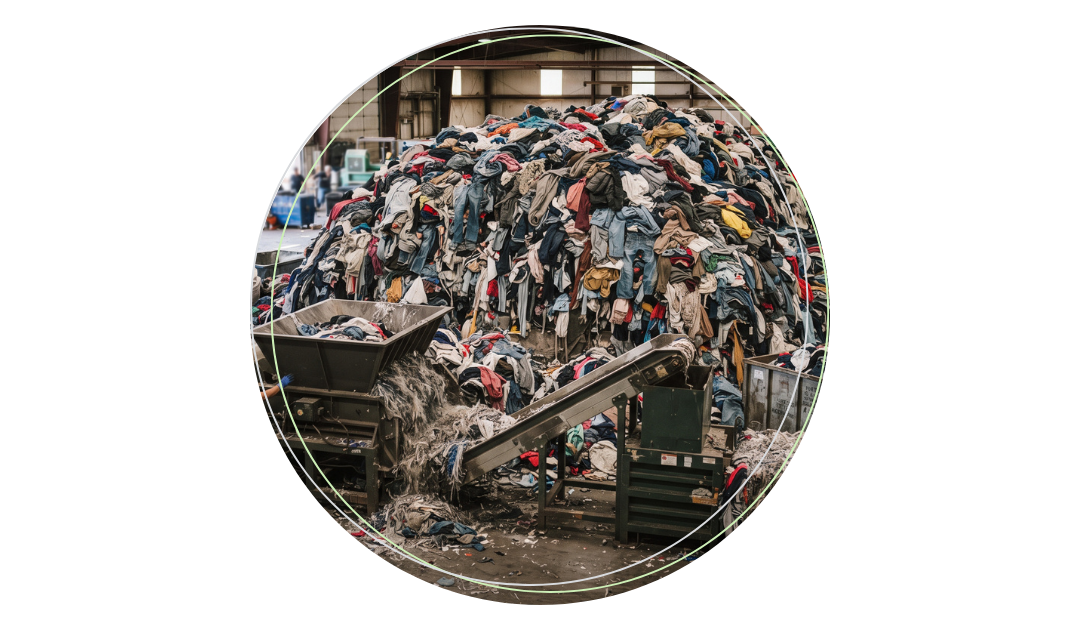
Every shop refit, office strip-out and retail refurbishment leaves a pile of material behind.
A lot of it still goes straight to landfill. Here is where that fitout waste actually ends up, why textile waste is such a stubborn part of the problem, and how recycled textile panels offer a practical way to divert some of it.
When a commercial space gets a new look, the old one has to go somewhere. Shopfitters strip out the old counters, wall linings, shelving, signage and fixtures, load it into skips, and cart it off site. Most business owners never see what happens next. The honest answer is that a large share of commercial fitout waste in Australia still ends up buried in landfill.
That matters for cost, for compliance, and increasingly for the sustainability commitments that clients and landlords expect. At BRL Sustainable Solutions we think the fitout industry can do better, and part of the answer sits in an unexpected place: textile recycling. This post walks through where commercial fitout waste goes, why textile waste is a big piece of the picture, and how recycled textile panels change what "landfill" has to mean.
Where commercial fitout waste actually ends up
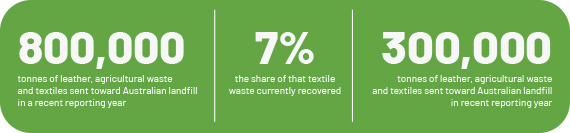
Construction and demolition activity is one of the largest waste streams in the country. Australia generates roughly 27 million tonnes of construction and demolition waste a year, which works out to close to 44% of the nation's total waste. Fitout and strip-out work feeds directly into that stream.
Commercial fitout waste is a specific and messy slice of it. When researchers measured 23 office fitout strip-out projects in premium Sydney buildings, they found that out of 9,167 tonnes demolished, 5,042 tonnes went to landfill, more than half. The main culprit was mixed waste generated by fast-track demolition, where different materials get jumbled together and become hard to separate and recycle.
It is worth being clear-eyed about recovery claims, too. A 2025 analysis of 142 building projects found that while many construction projects report a landfill diversion rate of around 90%, actual recycling of that diverted material can run much lower, with some material recovery rates as low as 14%. In other words, "diverted from landfill" and "actually recycled into something new" are not the same thing.
The takeaway is simple. Commercial fitout waste is heavy, high-volume, and often mixed, and a meaningful portion of it is still going into the ground. That is the problem worth solving.
Why textile waste is a big part of the problem
When people picture fitout waste they think of timber, plasterboard and metal. Textiles rarely get a mention, yet textile waste is one of the country's most overlooked and fastest-growing streams, and commercial and industrial activity drives a large share of it.
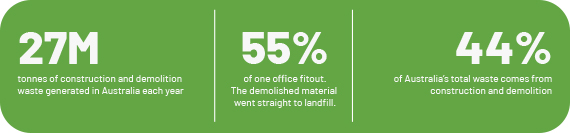
The national numbers are stark. Australians are among the world's heaviest textile consumers per capita, and the country sends an estimated 800,000 tonnes of leather, rubber and textiles toward landfill in a recent reporting year, recovering only about 7% of it. Here in Victoria, the state generates over 300,000 tonnes of textile waste a year, a figure that includes discarded clothing and uniforms, upholstery, synthetic carpets and manufacturing offcuts. According to Sustainability Victoria, the commercial and industrial sector generates just over half of that textile waste.
Two details make textile waste especially frustrating. First, most of it did not need to be wasted at all: industry bodies estimate that roughly 95% of textiles sent to landfill are potentially recyclable. Second, textile waste and commercial spaces are closely linked. Upholstery, carpet, soft furnishings and workwear all flow through the same retail, hospitality and office environments that shopfitters build and refurbish.
So we have two problems sitting side by side. Fitout waste fills skips with mixed material, and textile waste piles up almost entirely unrecycled. The interesting move is to solve one with the other.
How recycled textile panels change the picture
This is where BRL Sustainable Solutions comes in. Our recycled textile panels take material from the textile waste stream, that would otherwise head to landfill, and turn it into a usable building product for commercial fitouts. Instead of textile waste being a dead end, it becomes a wall panel, a surface, a finish, something a shopfitter can actually specify and install.
The logic is straightforward. Commercial fitouts need panels and linings. Textile waste is abundant, largely recyclable, and mostly unrecovered. By manufacturing panels from recycled textile content, we do two useful things at once: we divert textile waste from landfill, and we give fitout projects a material with a genuine recycled-content story behind it.
What we are not claiming. A single product does not solve Australia's waste problem, and no fitout is truly zero-waste. Recycled textile panels are one practical diversion measure among several. We would rather give you honest, sourced numbers and let the product earn its place than over-promise.

For the businesses commissioning a fitout, the appeal is practical rather than abstract:
- A real diversion story. Specifying recycled textile panels means a measurable quantity of textile waste is diverted from landfill on your project, not just an aspiration in a sustainability statement.
- Support for green building targets. Fitout waste-to-landfill benchmarks, such as those used in Green Star rating tools, reward projects that keep material out of the ground. Recycled-content materials support that goal.
- A credible answer for clients and landlords. More tenants, landlords and customers now ask what a business is doing about waste. A fitout built with recycled textile panels gives you something concrete to point to.
Fitout and recycling, working together
BRL Sustainable Solutions sits within BRL Contracting, a Melbourne commercial joinery and retail shopfitting company. That matters, because it means recycled textile panels are not a product dreamed up in isolation. They come from people who work on real fitouts, who fill real skips, and who see where the waste goes.
Textile recycling will not fix commercial fitout waste on its own. Timber, plasterboard, metal and mixed waste all need their own solutions. But recycled textile panels prove a point worth proving: material that is heading for landfill can be re-directed into the very fitouts that would otherwise send more waste there. That is a small, concrete shift in where your commercial fitout waste actually goes, and it is the kind of shift we think the industry should be making more often.
Interested in recycled textile panels for your next fitout?
Talk to BRL Sustainable Solutions about specifying recycled textile panels on your commercial or retail project, and building a fitout with a diversion story you can stand behind.
Sources
- YourHome (Australian Government), Waste minimisation, on construction and demolition waste as ~27 million tonnes / ~44% of national waste. gov.au
- Quantifying demolition fitout waste from Australian office buildings (Sydney CBD study, 23 projects): 5,042 of 9,167 tonnes to landfill. ResearchGate
- Clean Energy Finance Corporation, Australia's waste[d] opportunity 2025: reported diversion vs actual recovery rates. com.au
- Bundle Waste, Textile & uniform recycling for Australian business: ~800,000 tonnes and ~7% recovery. com.au
- Sustainability Victoria, Textiles circular economy opportunities: Victoria's 300,000+ tonnes and commercial/industrial share. vic.gov.au
- Textile waste management in Australia: A review (ScienceDirect): ~95% of landfilled textiles potentially recyclable. com
- Green Building Council of Australia, Construction and demolition waste credit (Green Star): fitout waste-to-landfill benchmarks. org.au
BRL Sustainable Solutions, part of BRL Contracting, Melbourne. Figures cited are drawn from published Australian sources and reflect the most specific data available at time of writing.