Every year, large volumes of discarded clothing and fabric offcuts end up in landfill or are burned.
Most of it never gets a second life. Master batch pellet technology offers a different path.
It takes textile waste that would otherwise be thrown away and turns it into a raw material that factories can mould into brand new products.
At BRL Sustainable Solutions, we pay close attention to where materials come from and where they end up. As part of our sustainable solutions work, we follow the technology that makes recycled materials genuinely useful in retail and commercial spaces. Master batch pellets are a big part of that story.
What is a master batch pellet?
A master batch is a small pellet packed with recycled material. Think of it as a concentrated building block. In this case, the pellet is made mostly from recycled textile fibre, so it holds the value of old clothing and fabric offcuts in a form that manufacturers can actually use.
Once made, these pellets can be melted and shaped into new products, much like the plastic pellets used to make everyday moulded items. The difference is what sits inside them.
How the process works
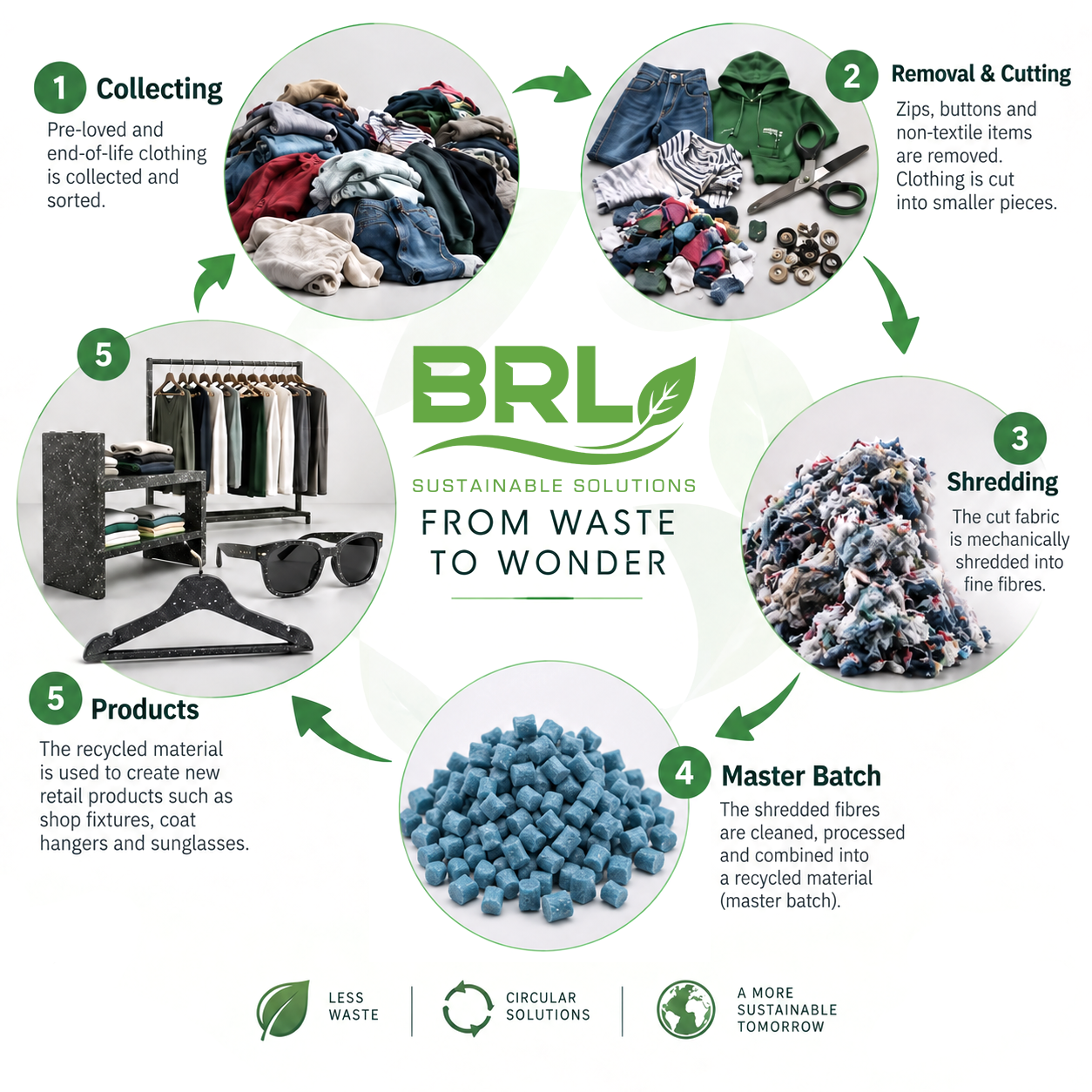
The journey from waste to finished product runs through six clear steps.
- Collecting. Discarded textiles are gathered from sources such as denim factories and clothing manufacturers.
- Removal and cutting. Any parts that cannot be used are removed, and the material is cut down.
- Shredding. The textiles are shredded into small, workable pieces.
- Master batch. The shredded fibre is compressed and pelletised into master batch pellets.
- Injection. The pellets are melted and injection moulded into a chosen shape.
- Products. The result is a finished item, ready to use.
What makes the technology clever
Recycling mixed textiles is usually difficult, because different fabrics have to be separated first. This technology, developed by our manufacturing partner Eco-Wynist, skips that step. It uses a fibre compatibility process that lets different textile materials be compressed and pelletised together, without sorting them by type. Eco-Wynist reports that the resulting pellets contain more than 50 per cent recycled fibre.
Removing the need to separate materials makes recycling faster and more practical at scale, which is one of the main reasons this approach stands out.
From pellets to real products
The master batch pellets do not stop at fibre. They can be combined with recycled plastics, including recycled polypropylene (rPP), recycled ABS (rABS), recycled PET (rPET) and recycled polyethylene (rPE), to create stronger composite pellets suitable for injection moulding.
The examples in the process are worth noting: coat hangers, sunglasses and flowerpots. For retail spaces, the hanger is the one to pause on. Hangers, display fittings and small fixtures fill every store, and they are almost always made from new plastic. Producing them from recycled textile waste is a practical, visible way to bring sustainability into a fitout.
Why this matters for retail and commercial spaces
Sustainable materials are no longer a nice extra. More retailers and brands want their spaces to reflect their values, and customers notice. Master batch pellet technology gives BRL Sustainable Solutions another way to help clients build fitouts that look sharp while reducing reliance on new plastic.
This technology also sits behind our Waste to Wonder panel range, developed with Eco-Wynist, which turns textile and other waste into unique decorative and functional panels for walls, fixtures and features. Same idea, different product: waste in, quality material out.
The takeaway
Master batch pellets show that textile waste does not have to be the end of the road. With the right technology, old fabric can become a hanger, a fixture or a feature in your next store. If you want to explore sustainable materials for your retail or commercial fitout, get in touch with the BRL Sustainable Solutions team.
Frequently asked questions
What is a master batch pellet made from?
It is made mostly from recycled textile fibre, such as offcuts from denim and clothing factories, compressed into a small pellet.
What can master batch pellets be used to make?
Once blended with recycled plastics, they can be injection moulded into products such as coat hangers, sunglasses, flowerpots and retail fixtures.
How much recycled content do the pellets contain?
According to manufacturer Eco-Wynist, the fibre master batches contain more than 50 per cent recycled fibre.