If you design retail spaces, offices or commercial fitouts, you already know how much a material choice can shape a project.
Recycled panels are quickly becoming one of the most talked-about options on the specifier's desk, and for good reason. But specifying recycled panels is a little different to specifying a standard off-the-shelf board, so this guide walks you through what you actually need to think about.
At BRL Sustainable Solutions, we manufacture recycled panels made from waste material that would otherwise head to landfill. Because these are recycled panels built from reclaimed waste, they behave a bit differently to mass-produced products, and that difference is exactly what makes them worth understanding before you write them into a spec.
Here is the practical, plain-English guide to specifying recycled panels the right way.
What recycled panels actually are
Before we get into sizes and finishes, it helps to be clear about what you are specifying.
Our recycled panels are made mostly from waste material, with additives blended in to give the panel its strength and durability. So you are not compromising on performance to use a recycled panel. You are diverting waste from landfill and turning it into a solid, functional building product at the same time.
This matters when you specify recycled panels, because the material story is part of the product. A denim waste stream, for example, produces a blue, textured recycled panel. The waste that goes in shapes the panel that comes out. We will come back to this when we talk about finishes, because it is the single biggest thing that makes specifying recycled panels different to specifying a standard board.
Sizes: think custom, not catalogue
Here is the first mindset shift when you specify recycled panels.
Standard building boards come in fixed sheet size thickness. Recycled panels do not have to work that way. Because we manufacture them, panel sheets can vary and can be customised to suit your project.
For you as a designer or specifier, that is genuinely useful. Instead of designing around a fixed sheet size thickness and dealing with awkward offcuts, you can talk to us early about the dimensions your project actually needs. Whether you are cladding a feature wall, building retail store fixtures, or fabricating joinery, the recycled panels can be produced to suit the application rather than forcing the application to suit the panel.
Our simple advice: when you specify recycled panels, bring us into the conversation at the design stage. Tell us the sizes you are working toward, and we can advise on what is achievable. Early collaboration on panel sizing thickness almost always produces a cleaner, more efficient result than trying to retrofit a custom material into a standard-sheet mindset.
Finishes: the waste decides the look
This is the part specifiers find most interesting about recycled panels.
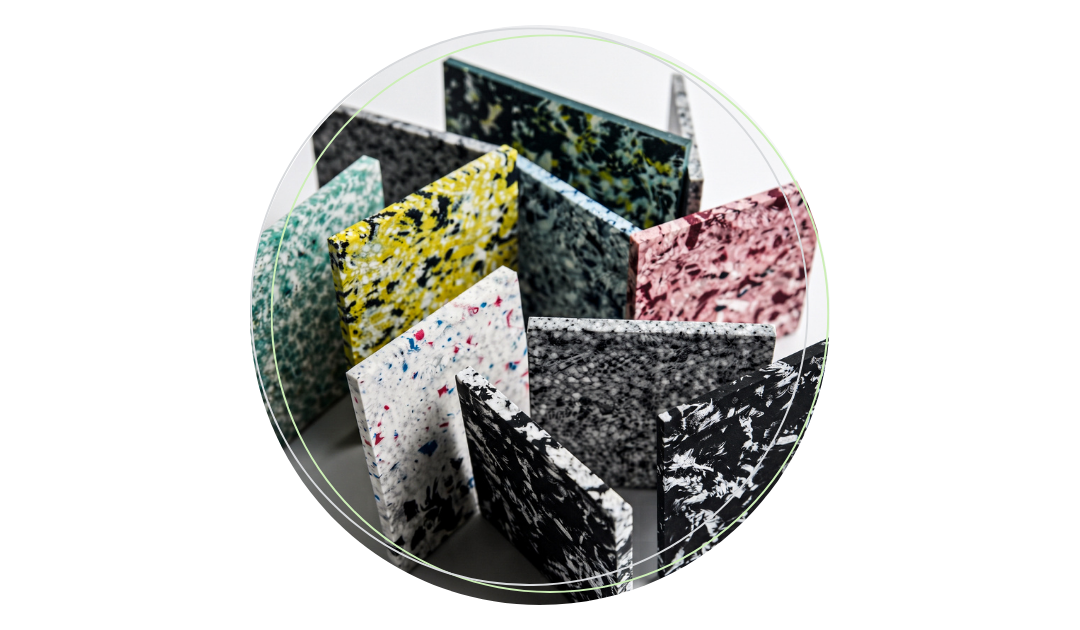
The finish and colour of the panel depends on the waste material used to make it. There is no fixed colour chart in the traditional sense, because the recycled panels take their character from their source material.
To use the earlier example, denim waste produces a blue, textured recycled panel. A different waste stream produces a different colour and texture. So the finish is variable, and that variability is part of the appeal. Every recycled panel carries a genuine material story, and no two waste streams look identical.
For specifiers, this means two things:
First, talk to us about the look you want before you lock in your finishes schedule. If you have a particular colour direction or texture in mind for a feature wall or a retail fitout, we can discuss which waste streams get you closest to it.
And here's the part most people love. You don't have to work only with our existing waste streams. If your business has its own textile waste sitting around, think old uniforms, fabric offcuts, retired branded merchandise or production scraps, we can turn that material into your own one-of-a-kind panels. It means the feature wall in your fitout isn't just recycled, it's made from your story. No other business in the country would have the same panel, because no other business has your waste.
Second, set client expectations accordingly. Recycled panels are not a printed laminate with a perfectly repeatable finish. The natural variation is the point. Clients who value sustainability and authentic materials tend to love this, but it is worth framing it for them early so the variation reads as a feature, not a surprise.
Fire ratings: what to confirm before you specify
Now to the question every specifier has to answer, and the one we will not gloss over.
Fire performance is not something to assume with any material, and recycled panels are no exception. Different applications carry different requirements under the National Construction Code, and the fire performance a project needs depends on the building class, the location of the panel and how it is being used.
So here is our honest position. Before you specify recycled panels for any fire-rated or compliance-sensitive application, talk to us directly about your specific project requirements. We will give you accurate, current information about what the panels can and cannot be used for, rather than a blanket claim that might not apply to your situation.
We would rather have that conversation up front than have you write a rating into a spec that does not match your project. If fire performance is a driver on your job, make it one of the first things you raise with us, and we will work through the actual requirements with you.
Applications: where recycled panels earn their place
One of the reasons designers are drawn to recycled panels is how versatile they are across commercial and retail work. The panels suit a wide range of applications, including:
- Retail store fixtures
- Office fitouts
- Joinery
- Feature walls
- Bench tops
Because the recycled panels can be customised in size, and because the finish carries a real material story, they work particularly well anywhere the surface is on show and the sustainability message adds value. A feature wall in a retail store, in an open-plan office, or a run of joinery in a fitout are all natural fits for recycled panels.
If you are specifying for a client who wants their space to reflect genuine environmental credentials, recycled panels give you a material that does the talking. The product itself is the proof.
How to specify recycled panels: a simple checklist
To pull it all together, here is a short, practical checklist for specifying recycled panels on your next project:
- Bring us in early. Because sizes and finishes are customisable, the best results come from talking to us at the design stage rather than at the end.
- Tell us your sizes/thickness. Panel sheets can vary and be customised, so share the dimensions your project needs. Keep in mind the maximum size is 2400x1200mm
- Discuss the finish you want. The look depends on the waste stream, so let us know your colour and texture direction.
- Raise fire and compliance requirements up front. Confirm what the panels can be used for on your specific project before you write anything into the spec.
- The panels are built to do more than look good. Selected panels in the range are moisture rated, which means they hold up in spaces most decorative finishes can't handle. Think bathrooms, change rooms, amenities and other wet areas. For a fitout, that's a real advantage. You can carry the same look from the retail floor right through to the wet areas without switching to a completely different material just because the space gets damp. One finish, one story, running all the way through the space.
- Set client expectations on natural variation. Frame the material story as a feature, because that is exactly what it is.
Specify recycled panels with confidence
Specifying recycled panels is not harder than specifying a standard board. It is just different. Once you understand that sizes are customisable, finishes are shaped by the waste stream, and fire performance needs a project-specific conversation, recycled panels become one of the most rewarding materials you can put into a commercial or retail design.
If you are an architect, designer or specifier looking at recycled panels for an upcoming project, get in touch with BRL Sustainable Solutions. Tell us about your project, and we will help you specify recycled panels that meet your design intent, your performance requirements and your sustainability goals.